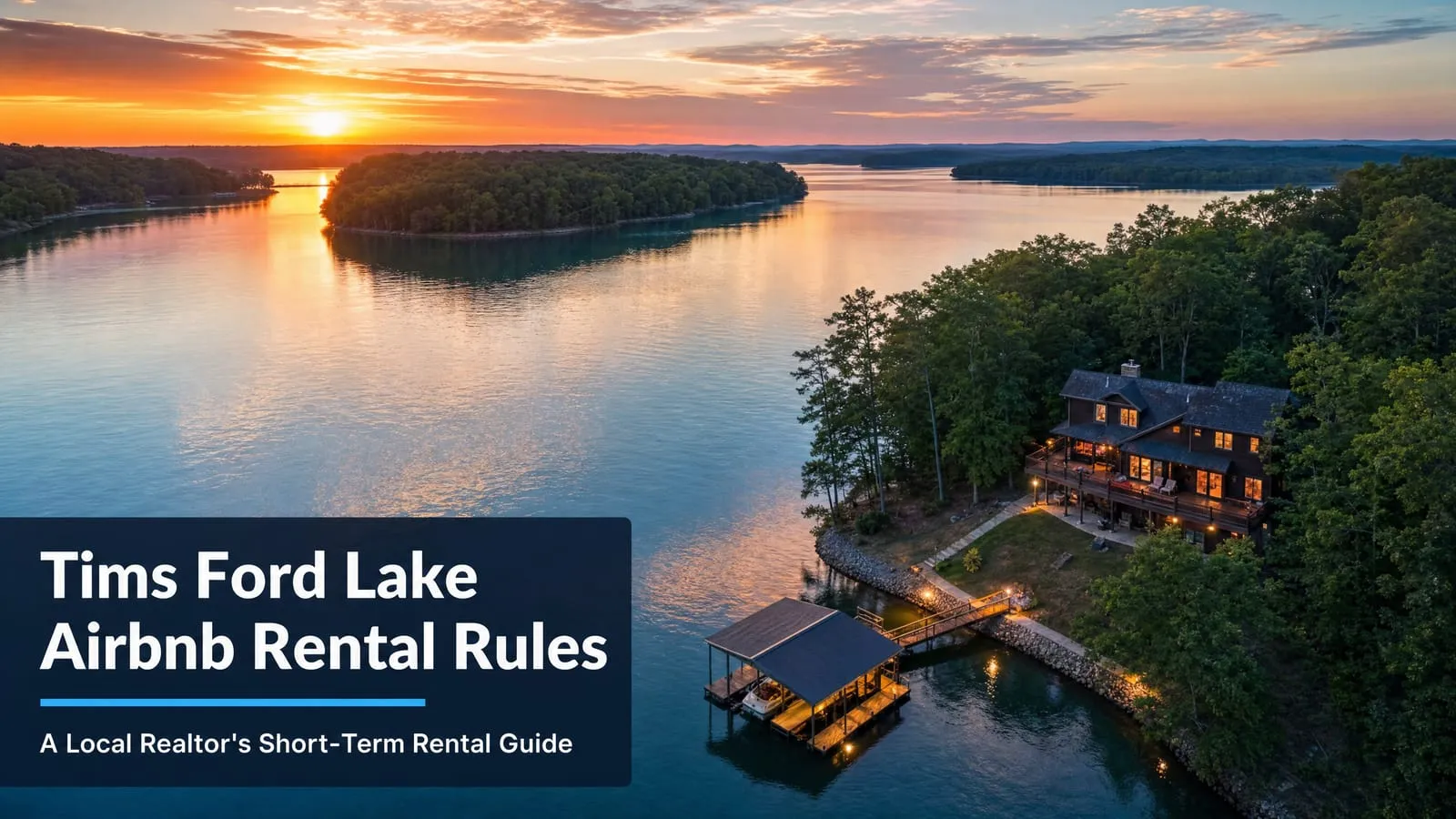

Tims Ford Lake Airbnb Rental Rules: A Local Realtor's Short-Term Rental Investor Guide
If you're researching Tims Ford Lake Airbnb rental rules as an investor, the answer is genuinely more complicated than it should be. Tims Ford's shoreline touches three different Tennessee counties — Franklin, Moore, and Coffee — plus multiple municipalities, each with its own short-term rental (STR) ordinance, permit requirements, and enforcement patterns.
A lake-access home on one road may be fully STR-eligible. The same-size home a mile away may be banned outright from non-owner-occupied rentals. The wrong assumption at the front of the buying process can cost you tens of thousands of dollars in lost rental income.
I've walked multiple investors through Tims Ford STR purchases over the past few years, and the single most important principle is this: verify STR eligibility at the specific address before you sign a purchase contract. Not the cove. Not the general area. The exact street address.
This guide walks through what the rules look like across the main jurisdictions so you know what questions to ask and where the pitfalls are.
Tims Ford Lake Airbnb Rental Rules: The Jurisdictional Map
Before any STR analysis, understand the map. Tims Ford Lake's shoreline and lake-adjacent residential properties fall into several governance zones:
City of Winchester — incorporated Franklin County municipality with its own STR ordinance.
City of Tullahoma — incorporated in parts of Franklin and Coffee counties, has its own ordinance.
Town of Estill Springs — incorporated Franklin County municipality with its own ordinance.
Unincorporated Franklin County — lake-adjacent properties outside any city limits, governed by Franklin County at the county level.
Unincorporated Coffee County — some Tims Ford shoreline sits in Coffee County, governed at county level.
Unincorporated Moore County — a smaller portion of the lake's western shore falls in Moore County.
The reason this matters: each jurisdiction has its own ordinance history, its own permit requirements, its own enforcement capacity, and its own interpretation of what counts as a short-term rental. An investor strategy that works beautifully in one jurisdiction may be illegal in the next. Verify your specific property's jurisdiction as the first step.
STR Rules in the City of Winchester
Winchester has taken a measured approach to STRs over the past several years. The city generally permits short-term rentals with registration, occupancy limits, parking requirements, and compliance with standard zoning rules. Certain residentially-zoned areas may have stricter limitations on STR operation, particularly when an owner does not reside on the property.
Key questions investors should verify with Winchester's planning office before buying: whether STRs are permitted in the specific residential zoning district, what registration fees and annual renewals apply, what occupancy caps exist, whether parking requirements affect which properties qualify, and whether non-owner-occupied STRs face different rules than owner-occupied (hosted) STRs.
Winchester's STR environment has been generally investor-friendly compared to peer-sized Tennessee cities, but ordinances change. Confirm current rules with the city directly, not from online forums.
STR Rules in the Town of Estill Springs
Estill Springs, as a smaller municipality, has historically had fewer formal STR restrictions than larger neighbors — but the town has been considering and updating its approach as lake tourism grows. Current investors should not assume "no rules" means "no rules coming."
Specifically verify: whether the town requires STR registration or business licensing, what (if any) occupancy and parking limits apply, whether the specific property zoning permits transient occupancy, and whether any new ordinances are under consideration that could affect future operation.
For context on Estill Springs as a market overall — who buys there, typical lake-access premiums, and the broader investor picture — the Estill Springs real estate complete guide covers the market foundation.
STR Rules in Unincorporated Franklin County
A significant share of Tims Ford lake-adjacent properties sit in unincorporated Franklin County, outside any city limits. For these properties, county-level zoning and regulations apply.
Franklin County has generally permitted residential STR operation subject to basic zoning compliance, though specific regulatory approaches can evolve. Investors should verify: the specific property's zoning district (residential vs. agricultural vs. other), whether the county requires any STR-specific registration or taxation beyond standard county business licensing, Tennessee state lodging tax compliance, and any HOA or subdivision covenants that may prohibit STR regardless of county rules.
That last point catches investors constantly. Some Tims Ford subdivisions have HOA covenants that forbid short-term rentals even where the county permits them. HOA governance trumps county permission. Always pull and read the complete covenant documents before assuming STR eligibility.
STR Rules in Coffee County and Moore County
Coffee County's unincorporated lake-adjacent areas follow county zoning, which has generally been permissive of residential STR with standard Tennessee state tax compliance requirements. Moore County's shoreline is smaller but similarly governed at the county level.
In all unincorporated areas, verify whether HOA or subdivision covenants apply and whether the specific zoning permits non-owner-occupied transient rental. Municipal vs. county governance is a distinction investors often miss, but it materially changes the rules in play.
The Tennessee State Lodging Tax Layer
Regardless of which county or city your Tims Ford STR property sits in, Tennessee state and local lodging tax obligations apply. Short-term rental income is typically subject to:
Tennessee state sales tax at the current rate (7% state portion plus local add-on, typically totaling 9.25%–9.75% depending on location).
State lodging tax and occupancy tax where applicable — rates and applicability vary by local jurisdiction.
County and municipal tourism or hotel-motel taxes in many Middle Tennessee jurisdictions — check with both the county and city for the specific property.
Airbnb, VRBO, and similar platforms collect and remit some of these taxes automatically in Tennessee, but not all. Investors are responsible for ensuring full compliance. Failure to register, collect, and remit applicable taxes has led to significant back-tax assessments for Tennessee STR operators.
Work with a Tennessee CPA who has STR-specific experience before you start operating. This isn't the place to DIY your tax compliance.
Looking at a specific property as a Tims Ford STR investment?
Browse active Tims Ford lake listings → I pull updated MLS inventory daily and can help investors verify specific property STR eligibility as part of due diligence.
The Investor Math: What Tims Ford STRs Actually Earn
Real revenue expectations for a Tims Ford Lake STR depend heavily on property type, location, amenities, and seasonal positioning.
A well-marketed lakefront 4-bed/3-bath home with private dock typically generates $45,000–$85,000 annually in gross STR revenue, with the higher end applying to premium waterfront homes with exceptional amenities (hot tub, lakeside fire pit, dock with boat slip) that charge $450–$700 nightly during peak summer weekends.
A lake-adjacent (non-waterfront) 3-bed home in a walkable-to-water location typically generates $22,000–$45,000 annually, charging $180–$325 nightly depending on season.
A non-lake but near-lake property can still work as an STR but depends heavily on price positioning, proximity to Tims Ford State Park, and quality of furnishings. Gross revenue $12,000–$25,000 annually is realistic.
Operating costs are meaningful: cleaning fees, utilities, linens, maintenance, insurance, platform commissions (typically 3–15%), and property management fees (if using a manager, typically 20–30% of gross revenue). Net cash flow after all costs on a Tims Ford STR typically runs 35–55% of gross revenue.
The HOA and Covenant Wildcard
I need to emphasize this because it catches investors constantly: HOA and subdivision covenants can prohibit STRs regardless of what the city or county permits.
Common covenant restrictions that kill STR investments:
Minimum rental periods (often 30 days minimum, effectively banning STRs).
Owner-occupancy requirements (property must be primary residence).
Explicit STR prohibitions by name (Airbnb/VRBO/transient lodging banned).
Permission-based rental systems (rentals require HOA board approval).
Before you write an offer on any Tims Ford property for STR purposes, pull and actually read the complete CC&Rs (Covenants, Conditions & Restrictions), HOA bylaws, and any amendments. Your agent should request and review these during due diligence. "We don't think there's an HOA" is not adequate — verify.
Risk Scenarios Tims Ford STR Investors Should Plan For
A few patterns that have hurt Tims Ford STR investors specifically:
Ordinance changes mid-investment. A property purchased under permissive rules can be affected when the city or county tightens STR regulations. Most municipalities grandfather existing operators, but grandfathering is not guaranteed. Factor regulatory risk into your underwriting.
Dock permit issues affecting the lake-access premium. A home's STR revenue often depends heavily on dock access. If the dock permit turns out to be problematic post-closing, STR revenue projections fall apart. The Tims Ford dock permit guide walks through what to verify before assuming lake access.
Seasonal revenue concentration. Tims Ford STR revenue is heavily summer-weighted. A property that grosses $65K over a year may book 70% of that revenue between Memorial Day and Labor Day. Cash flow planning must account for slow winter months.
Neighbor complaints leading to ordinance changes. Even where STRs are permitted, neighborhood complaints have driven regulatory tightening. Investors who manage properties with strict noise, parking, and trash protocols tend to fare better through ordinance transitions.
Insurance gaps. Standard homeowner's insurance typically does not cover STR operation. Landlord policies often exclude short-term transient rental. You need a specific STR-rated commercial policy, which runs more expensive than either standard homeowner or landlord coverage.
Ready to evaluate a specific property for STR potential?
Get a free Tims Ford home value estimate → I'll factor in STR potential, dock permit status, and jurisdiction-specific STR rules when analyzing the property for you — not a generic algorithm estimate.
Frequently Asked Questions About Tims Ford Lake Airbnb Rules
Can you Airbnb a house on Tims Ford Lake?
In most jurisdictions around Tims Ford, yes — with proper registration, tax compliance, and absence of HOA restrictions. But the specific rules vary significantly by city, county, and HOA, so always verify eligibility at the specific property address before assuming STR is permitted.
Which jurisdiction has the most STR-friendly rules around Tims Ford?
Historically, unincorporated Franklin County and smaller municipalities like Estill Springs have been more permissive than larger cities with active ordinances. But regulations evolve, and HOA covenants can override favorable local rules. Current-state verification is essential before purchase.
Do Airbnb hosts on Tims Ford need a business license?
Most jurisdictions require some form of business licensing, STR registration, or both. Tennessee state sales tax, lodging tax, and local occupancy taxes apply regardless of municipal registration requirements. Work with a local Tennessee CPA to ensure full compliance before you start hosting.
How much can I earn from a Tims Ford Airbnb property?
Lakefront properties with docks typically gross $45,000-$85,000 annually. Lake-adjacent non-waterfront homes typically gross $22,000-$45,000. Non-lake near-lake properties can work but usually generate $12,000-$25,000. Net cash flow after operating costs typically runs 35-55% of gross revenue.
Can an HOA prohibit Airbnb on Tims Ford Lake?
Yes. HOA covenants can restrict or prohibit short-term rentals regardless of municipal or county permission. Many Tims Ford subdivisions include minimum rental periods (often 30 days), owner-occupancy requirements, or explicit STR bans. Always read the complete CC&Rs before buying for STR purposes.
What taxes apply to Tims Ford Airbnb rentals?
Tennessee state sales tax (~9.25%-9.75% combined), state and local occupancy taxes where applicable, and county or municipal tourism/hotel-motel taxes in many Middle Tennessee jurisdictions. Platform auto-collection handles some but not all — work with a Tennessee CPA to ensure full compliance.
Ready to Invest in a Tims Ford STR Property?
Tims Ford Lake can be a solid STR investment market for buyers who do their homework and manage properties professionally. The lake's tourism draw is genuine, seasonal revenue is real, and well-positioned properties in STR-friendly jurisdictions have produced strong returns for years. But this is not a passive investment, and the jurisdictional complexity means you need local expertise to avoid expensive mistakes.
If you're evaluating a specific Tims Ford property as an STR investment, I'm happy to walk through jurisdictional rules, HOA covenants, dock permit status, and realistic revenue modeling for that property. I'd rather help you underwrite the deal accurately than sell you a property that doesn't pencil.
Schedule a free Tims Ford STR investment consultation → Share the property you're considering. I'll verify the rules and walk through realistic returns.
Sources
- Tennessee Department of Revenue — Sales and Use Tax — state tax framework
- Tennessee Department of Revenue — Lodging Tax — state occupancy tax rules
- City of Winchester Official Website — municipal STR ordinance information
- TVA — Tims Ford Lake Information — lake management and access
- Tennessee REALTORS Market Data — investment market benchmarks